Saturday, May 28, 2016

Cheap Chinese

Like India, China has an incredibly long history with ink.  Around the same time Egypt and China invented ink, some 4500 years ago, so it is unsurprising that most every method of laying down ink comes out of China these days.  Fine brushes, bamboo dip pens, and modern pens with a nib, printers, just to name a few.  Some of the finest everyday, don't-care-if-I-lose-it, fountain pens come out of China.  My three favorite companies are  Baoer, Hero, and Jinhao.  I don't recall paying more than $5 for any of these, and only one had shipping charges (the Baoer).  The Hero 616 was a real bargain, I believe I purchased 2 packs of 10 for under $20, free shipping included.  So now feast your eyes on the wonders below.
Cheap Chinese on cheap paper, because everyday, these have got to write on what's in the office
The Baoer and Hero are copies of the Parker 88 and Parker 51.  The Hero is almost a dead knock-off for the 51.  I own my father's 51 he used in college.  This writes nothing like it, but not that I'd expect it to for less than $1 per.  The Jinhao has a feel like it's attempting to be a Pelikan 140,  All are advertised as having a fine nib.
So let's look at them one by one:
Baoer 801 - A nice surprise from the Baoer, it is entirely metal, excepting the converter, the only one in the bunch, and pretty well made.  Sturdy construction, a very nice converter, I've paid more for worse converters than I have for this pen, a set-back for the cap, so it posts well, and the nib is pretty good.  Using the Montblanc Mystery Black it writes smoothly.  It has a rough time getting started in the morning, but flows well and writes consistently once it gets going.  
Hero 616 - I speculate this may be the most common fountain pen on the planet.  This body has appeared as numerous variants, has been broadly exported, has been used by generations of Chinese students, and is actually pretty reliable, once you get past the horrible quality control.  I believe this variant is referred to as the Extra Light.  It is plastic, except for the nib, cap, and part of the converter.  This is a an aerometric style converter, that works mostly ok, again quality control issues.  I found that 3 of these 20 were completely unusable.   When you get a good one, the steel nib works well with a thinner ink.  Quink works very well with this.  The nib is really more like an extra fine, if not finer, htat's why I recommend a thin ink.
The Jinhao is aesthetically a bit disjointed: the taper on the barrel is not smooth, the fittings are not flush to the cap, and the feel is definitely of plastic.  Overall, not bad, looking, but just unrefined.  The nib fitted to it says fine, but it writes somewhere between a medium and fine, and really lays down the ink.  This is an ink hog!  I wish that there was a bigger converter in it.  The writing experience is smooth, the posted weight of the pen is generous, and provides a nice balance, and the orange cap is striking and gets a lot of comments.  This is nice for lighter colored inks, since enough is laid down to really saturate the color.
So, where do I stand on these pens?  I love them, not because they write like my better pens, but because they write well enough for daily use, don't put me out any for than if I purchased a couple gel pens, and I don't have to worry about losing them.  I have handed out 10 or 12 of the Hero 616's to people who didn't even know that fountain pens were made any longer, and I've let kids, without worry of destruction, try their hand at writing without fear of loss or damage.  For some reason, the United States is moving away from teaching handwriting.  An entire generation is barely capable of writing (can't say much, mine penmanship bites) and don't see any value in it.  If we'd like to see writing continue, what better way than getting kids excited with a fountain pen.  They're just retro enough to get people jazzed about them.

Wednesday, May 18, 2016

CO Bigelow and Art of Shaving side by side

Art of shaving (L) C O Bigelow (R)
I'm on a shaving kick lately.  Do not know why, but something about seeing shaving ads for brands that push the multi-blade razors, with gel strips, swiveling heads, and contour handles just makes me anxious.  Soon I'm expecting a laser guided leveling system to be built right in, just so they can charge you more.  Of course, the latest retrend.  Let's stop there, retrend, I don't think that is a word, but I'm going to make it one.  It should only be used by people old enough to see the phenomenon, and secondly, it is when you see the same stupid junk being recycled, hyped, and made out to be new, when it really happened twenty or thirty years ago.  So, the latest retrend seems to be that everything has a lubricant built right into it, guaranteeing a frictionless shave.   Well, I still remember those horrible white strips from the '80's that disintegrated and actually screwed up the geometry of the shave the more they disintegrated.  Horrid.  It got me thinking that I don't experience that one bit.  Not at all.  Why?  Sharp single blades and good quality shaving cream.  As mentioned previously, I first found C O Bigelow when researching something other than shaving soaps, and like them so much I use a number of their products (a scent and lotion).  Lately, I've been using Art of Shaving Lemon Essential Oil cream, and find that I may like it more.  So, I'm doing a little side by side.  Prior to the actual comparison, I want to share a little about my experience with Art of Shaving.

I'd only seen art of shaving online, and found the prices to be a tad steep to just try and then possibly toss because I didn't like the product.  So, I dismissed them.  While on vacation in Vegas, we found ourselves in the Forum Shops at Caesars.  Among the watch stores, lord I could spend all day, and probably did, just looking in the stores, was an Art of Shaving store.  I had no idea they had stores, the nearest one being 20 miles through horrid traffic, but nearly ran in and dragged my wife in with me, scowling at me after putting up with hours looking at watches.  Isn't it usually reversed?  Hmmmmm......... Anyways, the salesman, oddly, was not well shaved.  Great beard, but scruffy and not trimmed.  Odd for a shaving store, but, extremely helpful, telling me about the various products and giving me a tidbit of info about finding your favorite blade, this there will be more on later.  Overall, amazingly helpful to see, smell, and touch the product.  I was impressed that it is so smooth.  Anyways, I was convinced to try their smaller tube, 2.5oz.
Art of Shaving on the brush
Art of shaving in the mug
You can see a slight sheen on this product.  It feels like there is a fairly high oil content.  It provides a very smooth shave, and what I like most is that it has a dense lather that stays put.  The lemon is not strong, I would say that it would do better with a stronger scent, but since I use aftershave every time I shave, really have nothing to complain about.
C O Bigelow on the brush
C O Bigelow in the mug
Note: I used the same amount of water and cream in each of these shaves.  The C O Bigelow is definitely foamier than the Art of Shaving.  It is stiffer and has just a touch of "slop" when applying.  It allows for a close shave, has enough oil to prevent any dragging, and has a stronger scent than the Art of Shaving.  This is due, I'm sure, to the fact it is a menthalyptus product.  I enjoy that it is pungent enough that you almost do not need to use aftershave if you just use whatever's left in the mug to wash you face with.  Very tingly.  I'd say these are pretty close in quality but feel that I get a closer shave with the Art of Shaving.  Packaging, Art of Shaving is more convenient, especially in the bathroom, but the Bigelow is more durable.  I've taken this tube on a 30+ day road trip without in leaks or breaks.  It looks sloppy, so it has got to stay under the sink, but the best choice for traveling.

It's hard to call.  I'm always open to suggestions on what products you like.  If you can convince me, maybe I'll give it a shot.

Sunday, May 15, 2016

Shaving soap or cream?

When I started this journey back to safety razors, I knew I needed a mug, brush, and soap.  The mug was easy, they were all over the second-hand stores and really, you can use almost anything.  There was a brief side-step to scuttles, more on that later.  I got a few, and found that I prefer the round bottomed ones.  Flat bottoms just didn't seem to lather as well.  Brush, a little harder, but found some in those same second-hand stores.  Don't be repulsed, you can sterilize them using alcohol.  The lather was actually the hardest to find.  No stores around carried anything but the white, round block of soap that doesn't want to build a decent lather.

So what about the soap?
In order to activate it, and start building a lather, a very wet brush is required.  This leaves a weak lather, that drips down the face and doesn't provide enough lubrication for a good shave.  It reminded me slime more than lather, and more importantly, the closeness that a safety razor can deliver never came through.
Secondly, no matter how much you drain the mug, the soap get mushy from the bottom up, sliding around the cup after a few days.  What was a disappointing shave before became frustrating as well, not what I was looking for.  I even got my hands on an antique scuttle, and tried that.  No go.  So had to find something else.

And if you know something that I gotta try, please let me know but this soap has got to provide a rich lather, maintain its consistency day to day (no mush and slime), and does not require a lot of water to activate.

So, I looked and looked.  Nothing, nada, zip.  I asked a couple local barbers what they used.  All used product meant for the profession.  Bulk.  Easy to use.  I can't buy.  But, did lead me down the road of a cream, and not that nasty self-foaming stuff you get in a can.  Ok, you say, why didn't I use the internet?  I have a love/hate relationship with shopping on the internet.  I love the convenience, hate the hands-off nature.  I prefer to read a box, smell it, and get some feedback from the sales person.  You can imagine how surprised I was going into Bath and Body Works just on a whim, and finding a nice selection of C. O. Bigelow.  I'd not used their products before, but being the only cream I could find, jumped on the chance to try it.  What a game changer.  After a few shaves, the learning curve was done.  I prefer a fairly rich, dry shave, wetting my face first, just a few drops of water, and a fingernail of cream. I can control the consistency perfectly.  Best, it is pungent with mint and eucalyptus and keeps any irritation to a minimum.

My biggest complaint: it's difficult to try various brands since most come in 3 or 4 oz sizes (or larger) which last me six to seven months of daily shaves.  I'd like to see (shaving stores do you hear me) collections of 10 - 20 small tubes, maybe .5 - .75 oz, that allow for easy trial of different brands.  More about others later.

Friday, May 6, 2016

Old metal better than new? : Or how to avoid the cult of shiny brass

So, maybe this is not strictly in line with what the blog is all about but it is a gripe that I have, and it does concern old stuff.  As an amateur musician and occasional teacher to beginning students of horn and trumpet, I see lots of beginners with instruments so bad that they are a detriment to their learning. The worst is, with just a knowledgeable eye and a little time, usually a better instrument, for less, can be had.   Sure, you might need to get $100-300 of repairs, but that's money well spent, especially if you paid much less for the instrument in the first place.  

So how can those bright, shiny, perfect looking horns from China (and a few other countries, but mostly China) cause problems with my child learning a brass instrument?  

First are the valves.  Most valves in cheap instruments are pot metal, or a very poor alloy of brass, with little or no plating.  These corrode quickly, become sticky, wear unevenly, and eventually slow down, and leak.  In order to play anything other than the most basic passages, they must move freely, quickly, yet fit tightly within their casings.  I have some fine horns with original valves, made of very high quality allow, thickly plated, that are still in great shape after 70 years.  Oiling and cleaning keeps them that way.  Bad valves in a used, or new for that matter instrument are easy to diagnose.  First, pull the slides without depressing the valve.  If there is a pop, the valve is tight within the casing.  Second, depress the lever.  If it is sticky, it can either be a slight seating issue, or it just has not be oiled.  If they are sticky, ask the shop's tech to oil them and get them moving as well as possible prior to trying.  If the linkage between lever and valve is mechanical, so no strings anywhere, and has any plastic parts, don't buy it.  For that matter, any plastic parts anywhere, generally a sign of cheap construction.  The only non-metal parts should be cork in the spit-valve and valves of a trumpet, felt in a trumpet valve, and hard rubber or silicone bumpers on rotary valves.

To the right, I just wanted to show the beautiful construction of this 80 year old spit valve.  Gorgeous hexaganol port, matching, hand-made bolt and posts, with a graceful trigger. Just elegant, and notice that it is almostly seamlessly jointed.  
T


Blind joint and joint using ferrule
Second is the actual construction.  This is mostly how well the brazing of the joints (where the different parts of the horn connect) is done and ow stiffly the braces hold the instrument.  Poor brazing will cause leaks, corrosion at the joints, and eventually structural failure, poor metal for the braces, leading to too much flexibility, means an inefficient transmission of the air through the instrument.  The following pictures are examples of some master craftsmanship that is nearly 80 years old, from a Blessing Artist trumpet, from the time all aspects of this instrument were made by Blessing or his son, and a small crew of master tradesman.  


Another type of ferrule, exception brace work

These three pictures show examples of the three main types of brazing construction techniques in an instrument: A blind joint, a joint with ferrule, and a brace.  Blind joints are used at the valve.  There is no piece of metal supporting the tubing as it enters the valves.  Look closely at the red oval in the first picture.  There is an extremely thin line around the joint.  It is even, not smudged, and still shiny after all this time.   The blue oval shows one edge of a ferrule used to join two lengths of tube.  The ferrule is made in house (most of these simpler ones were) to the exact diameter of the tubing, and positioned exactly over the silver being used to braze the material.  Again, it is clean and secure.  Another perfect braze.  
Close up detail of brace made using post and cup construction

The next picture has several great brazes.  The first is the white oval.  It is a brace being joined to the mouth piece receiver.  This brace is a solid piece of worked metal, adequately thick (but not heavy) and very stiff.  Not a drop or smudge or silver solder, not even built up behind the angle of the joint.  Secondly is the orange oval showing the ferrule used to join the inner "feet" of the first valve slide.  No smudges, and tight, you get the idea.  Finally, in the third pic is a type of brace usually used to establish width and add stiffness to larger slides.  These are made of three parts: the foot, cup, and post.  The three brazes, two in the yellow, and one in the light blue oval are all in a space just about 1/2".  They are clean, smooth, and solid.    

Thirdly, how the instrument feels in the hand.  There will always need to be adjustment of the finger pinkie hook, and possibly the addition of a "Duck's foot" rest.  Some of the cheap instruments, especially the ones marked ... "by [insert European country here] engineering" use such cheap metal, that soldering/brazing it is almost impossible to do, so adjustments are nearly impossible.  Whether buying new or used, don't cheap out and have the horn adjusted.  If it is a fixed hook, think about installing an adjustable pinkie hook.  It is about $80 to have it done, and will make the horn comfortable and able to grow with the student.  I play with both a pinkie hook and a duck's foot, aka hand rest, that allows for perfect comfort.  With the addition of foam to the duck foot, one can play hours without getting sore or cramping.  

Finally, one of the most demeaning and useless trends I've seen, is grade and middle-school music teachers demanding their students all use the same brand.  This type of thinking has led to fine brands contracting with outside firms to mass produce instruments at a price that satisfies the parents, who normally may not wish to spend the amount their intermediate or professional instruments might fetch.  It also ostracizes those students whose family cannot afford these instruments, and makes music a clique rather than a welcoming endeavor.  I ask any parent out there that faces this to directly address the school board and request that teacher change their policy.  

So, where does this leave us?  If you can afford to buy new, buy reputable new, and the best you can afford.  Of the cheap horns I've tried, there are very few I'd even wish on the most beginning student. The one I did like, new started at $1300.  Recently, I purchased for close to this price, a hand-made professional horn that needed very little work (just a cleaning really) to bring it to 100%.  As far as trumpets go, there are tons of fine companies out there that you can buy used and get work done for less than a new piece of garbage.  Olds, Reynolds, Blessing, Buescher, Besson, Boosey & Hawkes, and York all made excellent horns and trumpets that can be found used for $100-$600 and may required just a couple hundred in work, if you know what to look for.  Look back at the pictures in this article.  Sure, this is not a shiny instrument.  A large portion of the lacquer is gone, and some of the metal is pitted.  I saw it in the local vintage/antique store for $200, which was a good price.  Over the next three months, no one bought it, probably because it was obviously not new, and the price was reduced to $50.  So, a professional horn, with work that, if I had not done it myself, was probably $150.   I'd say $200 for a trumpet (add a $1500-2000 for a horn) that will last at least through high school is a wise investment.  

Thursday, April 28, 2016

Do you prefer Indian?

I've got pens, probably more than I should, a good percentage of those are ones I bought to fix.  When I actually get around to fixing them, I'll post that for sure.  While searching out more fantastic inks (I love Quink, Diamine, Herbin, and Noodlers) that would work in an eye-dropper pen (I'd been meaning to buy one for years) I came across a review for a hand-made pen by Ranga of India.  There are hundreds of brands out there I don't know, but something about India surprised me.  It shouldn't, the Sub-continent and surrounding lands have been masters of ink for thousands of years.  Indeed, some of the worlds most beautiful illuminated texts are in Sanskrit.  What really surprised me is that their starter pen, entirely hand-made to order, was $19.99 including shipping.  A bespoke pen for less than 20 dollars.  That I had to try.

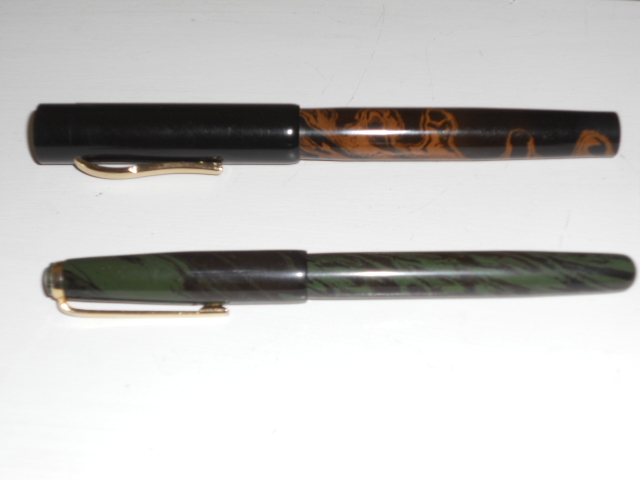
I first purchased the bottom pen, the Ranga model 2.  I have not been able to locate this pen on the Amazon or Ebay Ranga stores recently, so it is possible it is no longer offered.  It was $19.99  The top pen is the Large Duofold $29.99.  Both are made from the basic choices of Ebonite.  The model 2 is 5.75" and the Duofold 6".  Clearly, though, the Duofold is a more robust build, big enough no to fit in my largest two-pen case.  


Here are the same pens posted.  Both wear their caps securely, and look very nice.  They write well whether posted or not, but I prefer the balance provided posted, especially with the model 2, which can be a little light without the cap.  Posted they are each 1" longer than closed, so 6.75" and 7".


The Duofold: I don't own any of the original vintage Parkers, but per all I can find, this is a bit more generous. Take it as an homage to a classic.  The clip is appropriately generous, and nicely curved, giving it a little more presence that the slender one used on the 2.  I have it loaded here with Herbin Ink, Orange Indien.  It holds a whopping 3.5 cc's, and I've not had any problem with it being an eyedropper.  The nib writes like a fine, and is nicely smooth.

The Model 2: Nice and slim, and very classic looking.  I writes like a bigger pen, very comfortable, not cramped, which might be because of the curve to the body.  It writes best posted.  The clip is slender, modern, and naked, presumably epoxied the the cap.  I have it loaded with Mont Blanc Mystery Black.  It flows well, but not as well as the Duofold.  This could be one of two things: the smaller nib does not have enough surface area to draw as quickly, or the thicker Mont Blanc ink is better suited for a medium or medium-fine nib.  Once going, it flows well, and as with the Duofold, no problems with burps and such as one expects with an eyedropper.  

The Duofold is brown swirled Ebonite with a black cap, and the model 2 green swirl.  The basic colors offered are black in two finishes and olive, green, and brown swirl.  Speaking of the Ebonite, there are some beautiful options for an upcharge, usually marked in their description as "Rare."  If you want something different, these rare options can be quite striking.  Prior to these pens, I have never owned an Ebonite pen.  It feels warm to the touch and is smooth without having the sticky feel that acrylic can.  Beyond the Ebonite, Ranga also offers acrylic, and Ebonite with clear acrylic, their take on a demonstrator.  

Shipping has always been faster than estimated, and the customer service is excellent.  One receives an email fairly quickly requesting your choice of color, and any further correspondence is timely.  I like to support someone practicing a craft when I can, rather than purchasing from a factory/bulk producer.  When I can do that, and get a product better than what I could buy for the same price, it's even better.  

Monday, April 25, 2016

Growing pains, the horrors of a young shaver

I'm not unusually tall or hirsute, but as a child, I came into that early.  By 6th grade I was one inch shorter than I am now, so 6', and shaving every other day.  It didn't help that I was not especially gifted in sports, and just a little pudgy.  While boys struggled to grow a wisp of a mustache, I was being told to shave by teachers when I missed a day.  As with any pre-teen, I was also starting to get acne.  Shaving teen acne just makes acne worse.  Fun.

I remember asking at the end of 4th grade asking my father to shave my face after he finished cutting my hair.  He could actually cut hair pretty well, so never had that buzz cut most fathers give, and he had the proper tools for a shave.  That was the pace of things with facial hair, it needs a shave when my hair needed trimming, every few months or so.  But things changed pretty quickly after that.  By the end of the summer my father handed me his old Remington electric shaver and encouraged me to use it.  So, there I was shaving my face with an aging razor while getting acne.  Remington Microscreen certainly didn't shave closer than a razor, and unfortunately, I didn't get my money back.  Things just got worse.

Junior high was a horror of problematic acne, razor burn, facial rash, and attempting to figure things out.  I also found out I was allergic to aluminum, so most antiperspirants were out, ugh.  What a mess.  Sometimes I'd raid my sisters bic razor singles, but usually I just went two or three days, waiting for my face to heal, at which point my whiskers were long, and the famed Remington Microscreen would proceed to rip my face apart, chewing my follicles like they were bubble gum.  I'd go to school with a rash and bleeding acne.  WHEEE!


The above picture is a warning.  If you see anything resembling this, do not use it, or even think about it, unless you have the finest peach fuzz imaginable.  This will tear your face clean off.  

It went on for some time, exactly, through college.  For a graduation present I got a pen (that will be spoken of at some point) and razor,a really nice razor.  It was a Merkur Futur.  

The Merkur Futur is adjustable, very smooth shaving, and heavy enough to be comfortable in the hand.  I used it off-and-on for nearly 10 years.  Why off and on?  While living in Southern California the double-edged blades were kept behind the counter at most drug stores, or just not sold.  Crazy, right, but they were one of the most stolen products.  If you've spent all your money on coke, I guess you have to steel the blades.  Oh, and then when living in the East Bay, I could hardly find them because they were "Ecologically insensitive."  WHAT?!?  Like those plastic cartridge, or disposables are really eco-friendly.  I didn't feel like growing a beard, so I'd shave with that old electric, and then when I could find blades I'd buy all I could find, use them up, and then suffer.  My only complaint about this amazing razor, is that some of the parts used in its construction are not, as the Germans would say, rostfrei.  After a decade, it started having major problems.  Uneven shaving, and a loose handle.  I looked carefully, and it was actually blowing apart from the inside.  I decided, unwisely, to try a top notch Panasonic electric.  Mistake.  But due to a no return policy, it still sits in a drawer.  That's one of my main complaints about razors, I understand about the sanitary aspect, but some are amazingly expensive, whether electric or safety, and quite an investment.  Hopefully you'll find some help here.  So what's a razor-burned, full-bearded dude to do?

Find it at your local junk store.  That's what I did.  While looking around for brass instruments at the local vintage and antique cooperative, I found two razors, a Gem 1912 and Gillette flare tip Super Speed.  The Super Speed is part of a broad family called one piece or butterfly razors, since the head opens like a butterfly.  I don't think I paid more than $20 for the two, and unlike earlier, was able to get double edged razors at the local drug store.  The shave from both of these are superior to anything I had used before this point, and are still two of my go to razors.  

I cleaned them thoroughly, soaked them in alcohol for a day, and then took an old toothbrush loaded
up with the finest car polish I had and scrubbed.  Clean, sterile, and newly shiny. 


The Gem 1912 (left), obviously a single edge. when newly loaded, can remove a heavy 3 day beard without a thought.  The Gem stainless blades blades are sharp enough to use against the grain after the initial shave with the grain.  It is aggressive and can, if handled improperly, cause bleeding.  The learning curve was about 3 shaves.  It is worth the scrapes.  

The Gillette Super Speed (right) is a much easier shave.  It doesn't handle the heavy multi-day growth, but as a daily shave, is very nice, probably one of the best I've used. It is not as close, but very gentle.  Mine is a 1959 (E) first quarter (1).  I have read that the Super Speeds from the 40's are even better, but the best come from 1951 and '52 when the brass shortage forced Gillette to make the handles from either stainless or aluminum.  There is an Aristocrat model that is open comb (like the ball-end 3-piece razors from the 20's) that I would imagine is a very close shave.  That I'd love to try. 

To note, both of these tarnish, the Gem much more since when purchased almost all the plating was worn down to the bare brass.  I repolished both again after a few months.  They never tug the skin when tarnished, but can when newly polished.  I suggest, if you get one of these vintage razors, gently polishing only once as part of the cleaning process, and letting them patina.  

So, now I've been using double and single edge razors exclusively for 12 years.  I have never had a rash, since, no bumps, no burn, and I can shave every day without worry.  In that time, it has also become harder to find those vintage razors for a reasonable price.  I have been lucky to get a number of them, never paying more than $12, but now my local shops, when they do have them, are all marked well over $25, and often in worse shape.  If you find them, buy them.  Try it out.  And try all the different blades available to you, many sites have tens of choices, if not hundreds, for double edged, and at least a few single edged.  

Friday, April 22, 2016

Learning to write

Learning to write was, shall we say, traumatic.  It's not that I did not want to learn to write, but was never good at it.  My first scribbles at home were as anyone might expect, wiggly, large, backwards, and malformed.  Kindergarten was the first real test of my skills, with basic math and three letter words.  I quickly found that if I could not read my own writing, neither could anyone else.  I did not finish that year with a penmanship grade higher than a "U," unsatisfactory.  If you do not know this system, it went something like this, E - Excellent, G - Good, S - Satisfactory, N - Needs improvement, U - Unsatisfactory.  So, Kindergarten, and I was already failing penmanship.  

I clearly remember working on my writing skills during the summer, working through the copy book, and using the handwriting tablet provided by the school.  You know the paper, with a little dotted line 2/3 up each space to indicate where the body of each lower-case letter is to go to.  I remember it looking good, and I was proud of what I had done.  I was even using the yellow pencil, and not the fat, red, beginners pencil.  I returned to school certain I would pass penmanship and not look like a fool.  My first assignment, copying words from the board, earned me another U in penmanship.  HOW?  Adding to my trauma, I was now made to use a big red pencil with a bright blue triangular grip announcing to the world at large that I was incompetent with my handwriting.  


I continued to struggle with my writing through all of the grades that they actually graded you on your penmanship, that was third in my school.  Never once did I break N.  If anything, my writing became worse when we were required to use a pen.  I had those horrible BIC Cristal pens, which scratched across the paper, did not lay down enough ink, blobbed at the end, and were so tiny my hand cramped using them.  I should have realized the teachers made me use the grip for a reason, so I would not have to grip the pencil like a crab just to hold it steady.  Rather, I found that if one popped the cartridge out and pull the top off, the taper of front and slickness of the barrel made for the perfect spit ball tube.  Combine that with a cornet mouthpiece (we all started music in third grade) and one could get a wad to stick to the blackboard from across the room.  Brilliant.  The second half of primary school was filled with returned papers with underlines asking indicating words they could not read.  I first experimented with the family typewriter at some point in here, acquiring a portable Royal as well, at a garage sale.  I was so enamored with it that I walked all the way home to get my saved money, and getting back just as they were packing up.  I had $20 in change and singles.  I lugged that monster 1 1/2 miles uphill.  Still have it.


Progressing to junior high, I actually had some anxiety about writing, I remember my siblings telling me there was a lot of in class writing.  The summer prior, in my wanderings about Berkeley with my best friend, I found a pen.  It was a Parker (like the Rialto) that took cartridges.  Being Berkeley, there were stationers about, lots of them.  So I stopped in and asked what kind of refill it took.  They handed me a pack of black cartridges.  I took it home and was hooked.   


My handwriting changed.  My nerves about the in-class essays changed, everything looked great, until I found out about how fast these cartridges ran out.   Back to the stationer.  Again, for $2 I got a converter, which let me refill my pen with ink from a bottle.  I purchased a second Parker, a fairly cheap one, something I'm sure was under 10 bucks.  And it came with a converter!  Joy, now two pens, full every day for school.  I still have those pens 30 years later.   The top one is the one I found, and the bottom the one I bought.


I ran against ups and downs during my Jr and Sr high years, teachers that applauded me for using a proper "Writing instruments" while others complained that I wasted paper because the ink bled through (paper is for a whole other post) and I used only one side.  The day my grandfather, who was one bad-ass engineer, saw me writing with a fountain pen was one of my writing highlights.  In response he pulled out his engineers field drafting kit, given to him by his brother-in-law.  He carefully put together the pens, and dipped them in a bottle of India ink.  He spent minutes concentrating, just pulling straight lines, then carefully lettered his name, and cleaned all the pens.  "That's why none of those new drawings look write, there's no soul."  He then handed me that kit.  To this day, I have not had the strength to use it.  

What am I saying?  I'm not really sure, but if we're going to write, we should choose something we're comfortable with.  I think I'm also saying, we should be open to some older technologies that use fewer resources, last longer than a year or two, and by spending a few extra bucks (sometimes, not, that's another post) employ people in a craft that can sustain them financially, and brings us joy at the same time.