Showing posts with label Pens. Show all posts

Wednesday, July 6, 2016

There's a range to cheap, Pakistan to Japan

There is a range to cheap.  I've not seen a fountain pen within the past decade, that was less than $1.50.  Then there's the to end of cheap, which hovers around $20.  Above that, I have to think a bit and consider quality, writing pleasure, aesthetics, the whole package, more than I would otherwise. Today I'm looking at two recent acquisitions where I spent just about the same. The difference being I spent the same amount on one pen as on ten of the other.   An order of magnitude, and I'd say the same for quality.  


Dollar 717i loaded with Seitz Kreuznach Cinnamon Brown, MoMa MUJI with Manuscript/calligraphy.co.uk blue
 Both brands of pen and ink are new to me.  The Dollar 717i was just under $20 for 10, while the MoMa MUJI pen was about the same with shipping.  The Seitz-Kreuznach had received some excellent reviews, especially for the price-point at just under $9.  The Manuscript blue was a desperate buy from a local art store when I needed a bright blue.  The store had misordered fountain pen ink instead of calligraphy ink, and was on sale for $2, at the latest exchange rate, off-sale it would be about $6.

First the pens:

Dollar 717i
 The Dollar 717i isn't quite a buck, but very close to it.  The general construction, is somewhat better than I would expect for the price, but still, I won't be expecting it to last more than a year or two, and won't care when it finally fails.  Except for the medium-fine nib, it is entirely plastic.  A couple nice bonuses, a clear section that allows for viewing the ink, and a piston fill action.  No leaks whatsoever, and a smooth fill.  I have carried this around all and had no problems at all starting flow, and the nib is fairly smooth.  The cap fits very tightly, almost uncomfortably, since it can take some effort to take off.  This might be something to do with plastic on plastic adhesion.  I can only hope it will become easier after awhile.  I have already handed one of these out to someone who was interested in trying a fountain pen and ball points exacerbate her carpal tunnel due the pressure she has to apply to lay down ink heavily enough.  She has had this a week and hopefully it will work for her.

MoMa MUJI
Here's a company I knew nothing about.  There's a store nearby, that I must see next time I'm in town. MUJI, reading their "About us" section and looking at their aesthetic, I appreciate what they are doing and think that the first paragraph from that about us section is worth reposting here:
MUJI was founded in 1980. Its origin was a thorough rationalization of the manufacturing process with an eye to creating simple, low-cost, good quality products. Specifically, we reexamined products through three lenses: material selection, inspection process and packaging simplification. For instance, if you omit the bleaching process for pulp, the resulting paper is light beige in color. MUJI used this paper for its packaging and labels. The ensuing products are remarkably pure and fresh. In notable contrast to the prevailing over-embellished products in the marketplace, MUJI’s products both won great appreciation and sent shock waves not only through Japan but across the entire world.
I think this pen speaks perfectly to this statement.  It is a simple, very well designed piece, constructed from beautiful, tightly fitting aluminum, and the packaging was a basic sleeve with what appear to be instructions (I do not read Japanese) printed on recycled paper.  My overall impression looking at it for the first time, much more for your money.  This is a pen that would be happy amongst any $40 or $50 pen.  The aluminum is a nice matte finish, with a knurled grip.  It is very difficult on such a simple design to hide joins between the barrel and section, and the cap and section and cap and barrel when posted.  That the join line is minimal speaks to the machining and design.  The weight is noticeable, but not heavy.  It came with one refill.  I ordered an international size converter, but while waiting for it to arrive, used a much older one that I had removed from another pen.  The MUJI pen must have very tight tolerances, or the old converter had warped, since it leaked like crazy.  The new converter fits perfectly, no leakage, and the flow is smooth and even.  The fountain pen being sold now is very similar, but do not know if the MoMa design is still being produced.  Stock is obviously available, but may not be replenished.  Though I cannot for sure say that they are the same innards, I do not see why they would not be.  This is a definite buy recommendation.  As an every day pen, this is great, hell, as an anytime writer, it will be enjoyed.  As testament to this, the ink loaded in it is not my favorite, not saturated and drying time is long, I still find this better than many of my pens.

Now to the inks.  First the not so great, Manuscript blue.  A few years back, I ran out of all my inks, almost simultaneously, and did not know that no local art or office store was carrying fountain pen ink.  I found this on a discount table and decided to give it a whirl.  I have written with this ink using extra fine nibs through medium, in cheap and luxury pens.  It's a nice color.  I like this blue.  Unfortunately, I find that the saturation is weak and no matter the pen, seems to come across as inconsistent, leaving blotches.  Why this happens I've no idea, and it really is the only ink I've seen it to this degree.

For just a few bucks more, you can have the joy of writing with the Seitz-Kreuznach.  Loaded in the Dollar 717i, I suspect the ink is actually adding a great deal to the writing quality of the pen.  It is a consistent, very easy flowing ink, with a moderate dry time.  While I really like the cinnamon color, I've had a few people say it looks like dried blood.  One way or the other, it is a smooth color that reads as a true brown.  So many browns are so dark to basically be black, or so light, it appears weak or washed out, this one is not.  At work, I've used this on a number of different color sticky notes, and even with the background color, it comes across strongly.  Unfortunately for me, I'm well stocked with ink, and should not be buying anymore in the near future, but I would really like to try some more in the Color of Nature series.

I'd love to see more people trying fountain pens as their go to writing instrument, and either of these would push that in the right direction.

Saturday, May 28, 2016

Cheap Chinese

Like India, China has an incredibly long history with ink.  Around the same time Egypt and China invented ink, some 4500 years ago, so it is unsurprising that most every method of laying down ink comes out of China these days.  Fine brushes, bamboo dip pens, and modern pens with a nib, printers, just to name a few.  Some of the finest everyday, don't-care-if-I-lose-it, fountain pens come out of China.  My three favorite companies are  Baoer, Hero, and Jinhao.  I don't recall paying more than $5 for any of these, and only one had shipping charges (the Baoer).  The Hero 616 was a real bargain, I believe I purchased 2 packs of 10 for under $20, free shipping included.  So now feast your eyes on the wonders below.
Cheap Chinese on cheap paper, because everyday, these have got to write on what's in the office
The Baoer and Hero are copies of the Parker 88 and Parker 51.  The Hero is almost a dead knock-off for the 51.  I own my father's 51 he used in college.  This writes nothing like it, but not that I'd expect it to for less than $1 per.  The Jinhao has a feel like it's attempting to be a Pelikan 140,  All are advertised as having a fine nib.
So let's look at them one by one:
Baoer 801 - A nice surprise from the Baoer, it is entirely metal, excepting the converter, the only one in the bunch, and pretty well made.  Sturdy construction, a very nice converter, I've paid more for worse converters than I have for this pen, a set-back for the cap, so it posts well, and the nib is pretty good.  Using the Montblanc Mystery Black it writes smoothly.  It has a rough time getting started in the morning, but flows well and writes consistently once it gets going.  
Hero 616 - I speculate this may be the most common fountain pen on the planet.  This body has appeared as numerous variants, has been broadly exported, has been used by generations of Chinese students, and is actually pretty reliable, once you get past the horrible quality control.  I believe this variant is referred to as the Extra Light.  It is plastic, except for the nib, cap, and part of the converter.  This is a an aerometric style converter, that works mostly ok, again quality control issues.  I found that 3 of these 20 were completely unusable.   When you get a good one, the steel nib works well with a thinner ink.  Quink works very well with this.  The nib is really more like an extra fine, if not finer, htat's why I recommend a thin ink.
The Jinhao is aesthetically a bit disjointed: the taper on the barrel is not smooth, the fittings are not flush to the cap, and the feel is definitely of plastic.  Overall, not bad, looking, but just unrefined.  The nib fitted to it says fine, but it writes somewhere between a medium and fine, and really lays down the ink.  This is an ink hog!  I wish that there was a bigger converter in it.  The writing experience is smooth, the posted weight of the pen is generous, and provides a nice balance, and the orange cap is striking and gets a lot of comments.  This is nice for lighter colored inks, since enough is laid down to really saturate the color.
So, where do I stand on these pens?  I love them, not because they write like my better pens, but because they write well enough for daily use, don't put me out any for than if I purchased a couple gel pens, and I don't have to worry about losing them.  I have handed out 10 or 12 of the Hero 616's to people who didn't even know that fountain pens were made any longer, and I've let kids, without worry of destruction, try their hand at writing without fear of loss or damage.  For some reason, the United States is moving away from teaching handwriting.  An entire generation is barely capable of writing (can't say much, mine penmanship bites) and don't see any value in it.  If we'd like to see writing continue, what better way than getting kids excited with a fountain pen.  They're just retro enough to get people jazzed about them.

Thursday, April 28, 2016

Do you prefer Indian?

I've got pens, probably more than I should, a good percentage of those are ones I bought to fix.  When I actually get around to fixing them, I'll post that for sure.  While searching out more fantastic inks (I love Quink, Diamine, Herbin, and Noodlers) that would work in an eye-dropper pen (I'd been meaning to buy one for years) I came across a review for a hand-made pen by Ranga of India.  There are hundreds of brands out there I don't know, but something about India surprised me.  It shouldn't, the Sub-continent and surrounding lands have been masters of ink for thousands of years.  Indeed, some of the worlds most beautiful illuminated texts are in Sanskrit.  What really surprised me is that their starter pen, entirely hand-made to order, was $19.99 including shipping.  A bespoke pen for less than 20 dollars.  That I had to try.

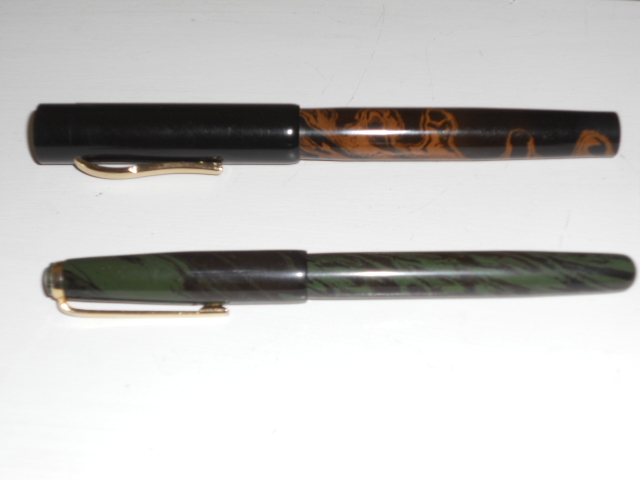
I first purchased the bottom pen, the Ranga model 2.  I have not been able to locate this pen on the Amazon or Ebay Ranga stores recently, so it is possible it is no longer offered.  It was $19.99  The top pen is the Large Duofold $29.99.  Both are made from the basic choices of Ebonite.  The model 2 is 5.75" and the Duofold 6".  Clearly, though, the Duofold is a more robust build, big enough no to fit in my largest two-pen case.  


Here are the same pens posted.  Both wear their caps securely, and look very nice.  They write well whether posted or not, but I prefer the balance provided posted, especially with the model 2, which can be a little light without the cap.  Posted they are each 1" longer than closed, so 6.75" and 7".


The Duofold: I don't own any of the original vintage Parkers, but per all I can find, this is a bit more generous. Take it as an homage to a classic.  The clip is appropriately generous, and nicely curved, giving it a little more presence that the slender one used on the 2.  I have it loaded here with Herbin Ink, Orange Indien.  It holds a whopping 3.5 cc's, and I've not had any problem with it being an eyedropper.  The nib writes like a fine, and is nicely smooth.

The Model 2: Nice and slim, and very classic looking.  I writes like a bigger pen, very comfortable, not cramped, which might be because of the curve to the body.  It writes best posted.  The clip is slender, modern, and naked, presumably epoxied the the cap.  I have it loaded with Mont Blanc Mystery Black.  It flows well, but not as well as the Duofold.  This could be one of two things: the smaller nib does not have enough surface area to draw as quickly, or the thicker Mont Blanc ink is better suited for a medium or medium-fine nib.  Once going, it flows well, and as with the Duofold, no problems with burps and such as one expects with an eyedropper.  

The Duofold is brown swirled Ebonite with a black cap, and the model 2 green swirl.  The basic colors offered are black in two finishes and olive, green, and brown swirl.  Speaking of the Ebonite, there are some beautiful options for an upcharge, usually marked in their description as "Rare."  If you want something different, these rare options can be quite striking.  Prior to these pens, I have never owned an Ebonite pen.  It feels warm to the touch and is smooth without having the sticky feel that acrylic can.  Beyond the Ebonite, Ranga also offers acrylic, and Ebonite with clear acrylic, their take on a demonstrator.  

Shipping has always been faster than estimated, and the customer service is excellent.  One receives an email fairly quickly requesting your choice of color, and any further correspondence is timely.  I like to support someone practicing a craft when I can, rather than purchasing from a factory/bulk producer.  When I can do that, and get a product better than what I could buy for the same price, it's even better.  

Friday, April 22, 2016

Learning to write

Learning to write was, shall we say, traumatic.  It's not that I did not want to learn to write, but was never good at it.  My first scribbles at home were as anyone might expect, wiggly, large, backwards, and malformed.  Kindergarten was the first real test of my skills, with basic math and three letter words.  I quickly found that if I could not read my own writing, neither could anyone else.  I did not finish that year with a penmanship grade higher than a "U," unsatisfactory.  If you do not know this system, it went something like this, E - Excellent, G - Good, S - Satisfactory, N - Needs improvement, U - Unsatisfactory.  So, Kindergarten, and I was already failing penmanship.  

I clearly remember working on my writing skills during the summer, working through the copy book, and using the handwriting tablet provided by the school.  You know the paper, with a little dotted line 2/3 up each space to indicate where the body of each lower-case letter is to go to.  I remember it looking good, and I was proud of what I had done.  I was even using the yellow pencil, and not the fat, red, beginners pencil.  I returned to school certain I would pass penmanship and not look like a fool.  My first assignment, copying words from the board, earned me another U in penmanship.  HOW?  Adding to my trauma, I was now made to use a big red pencil with a bright blue triangular grip announcing to the world at large that I was incompetent with my handwriting.  


I continued to struggle with my writing through all of the grades that they actually graded you on your penmanship, that was third in my school.  Never once did I break N.  If anything, my writing became worse when we were required to use a pen.  I had those horrible BIC Cristal pens, which scratched across the paper, did not lay down enough ink, blobbed at the end, and were so tiny my hand cramped using them.  I should have realized the teachers made me use the grip for a reason, so I would not have to grip the pencil like a crab just to hold it steady.  Rather, I found that if one popped the cartridge out and pull the top off, the taper of front and slickness of the barrel made for the perfect spit ball tube.  Combine that with a cornet mouthpiece (we all started music in third grade) and one could get a wad to stick to the blackboard from across the room.  Brilliant.  The second half of primary school was filled with returned papers with underlines asking indicating words they could not read.  I first experimented with the family typewriter at some point in here, acquiring a portable Royal as well, at a garage sale.  I was so enamored with it that I walked all the way home to get my saved money, and getting back just as they were packing up.  I had $20 in change and singles.  I lugged that monster 1 1/2 miles uphill.  Still have it.


Progressing to junior high, I actually had some anxiety about writing, I remember my siblings telling me there was a lot of in class writing.  The summer prior, in my wanderings about Berkeley with my best friend, I found a pen.  It was a Parker (like the Rialto) that took cartridges.  Being Berkeley, there were stationers about, lots of them.  So I stopped in and asked what kind of refill it took.  They handed me a pack of black cartridges.  I took it home and was hooked.   


My handwriting changed.  My nerves about the in-class essays changed, everything looked great, until I found out about how fast these cartridges ran out.   Back to the stationer.  Again, for $2 I got a converter, which let me refill my pen with ink from a bottle.  I purchased a second Parker, a fairly cheap one, something I'm sure was under 10 bucks.  And it came with a converter!  Joy, now two pens, full every day for school.  I still have those pens 30 years later.   The top one is the one I found, and the bottom the one I bought.


I ran against ups and downs during my Jr and Sr high years, teachers that applauded me for using a proper "Writing instruments" while others complained that I wasted paper because the ink bled through (paper is for a whole other post) and I used only one side.  The day my grandfather, who was one bad-ass engineer, saw me writing with a fountain pen was one of my writing highlights.  In response he pulled out his engineers field drafting kit, given to him by his brother-in-law.  He carefully put together the pens, and dipped them in a bottle of India ink.  He spent minutes concentrating, just pulling straight lines, then carefully lettered his name, and cleaned all the pens.  "That's why none of those new drawings look write, there's no soul."  He then handed me that kit.  To this day, I have not had the strength to use it.  

What am I saying?  I'm not really sure, but if we're going to write, we should choose something we're comfortable with.  I think I'm also saying, we should be open to some older technologies that use fewer resources, last longer than a year or two, and by spending a few extra bucks (sometimes, not, that's another post) employ people in a craft that can sustain them financially, and brings us joy at the same time.